Infinity Pools Auckland: Costs, Sites & What's Involved
Infinity pools look simple in photos. They're not. Behind the visual effect is a structure that is meaningfully more complex than a standard in-ground pool, and in Auckland, that complexity has a real price attached. This guide covers what an infinity pool actually involves to build, why it costs substantially more than a standard pool, which Auckland sites genuinely suit them, and what realistic cost ranges look like in 2025/2026.
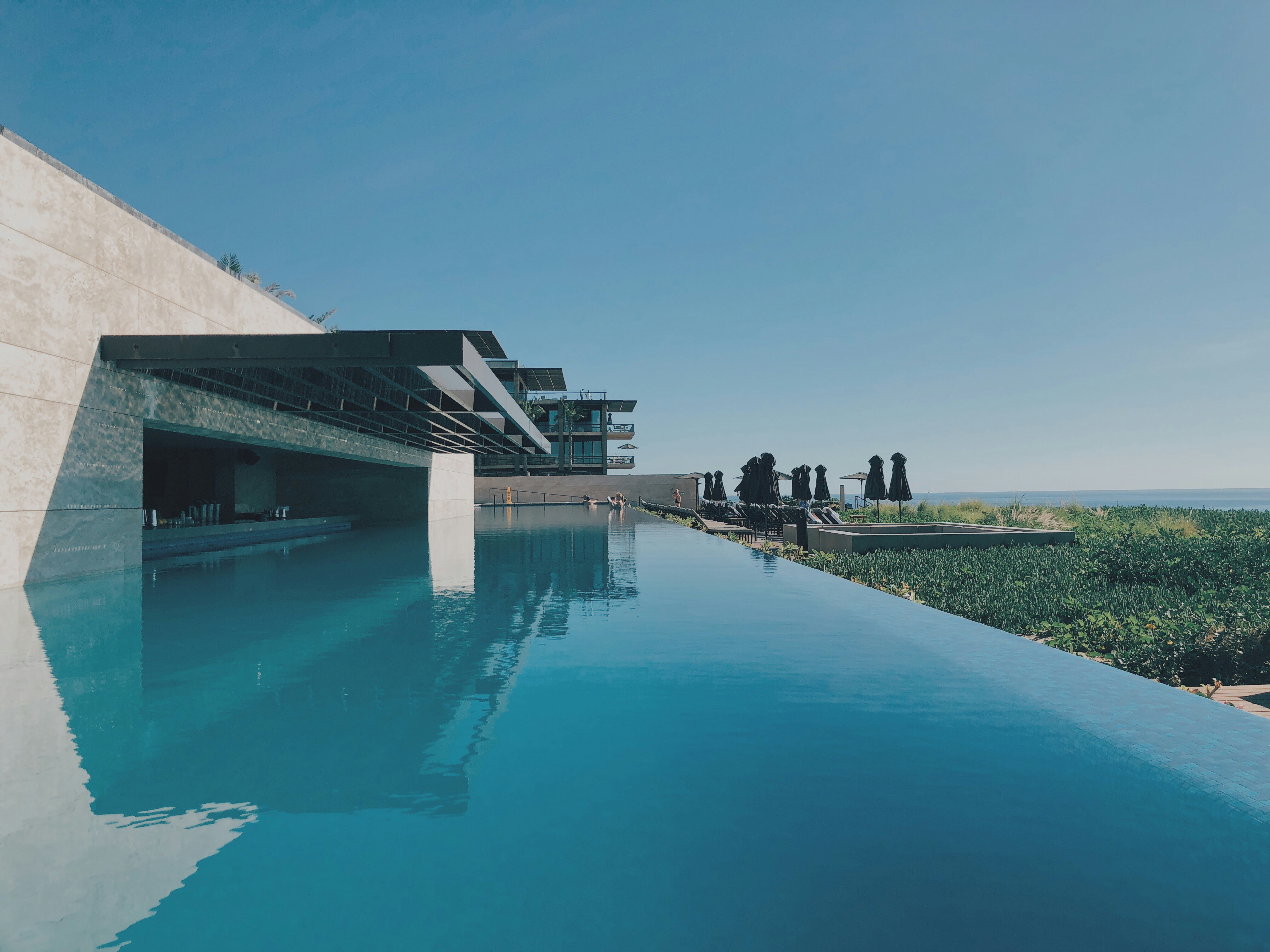
What Is an Infinity Pool?
An infinity pool (also called a vanishing edge pool or negative edge pool) creates the visual illusion that the water extends to the horizon. One or more edges of the pool sit above a concealed catch basin. Water flows continuously over the edge, into the basin below, and is pumped back into the main pool.
The effect is visual. The engineering behind it is not.
What Makes the Structure Different
A standard pool holds water behind four walls. An infinity pool is designed so water intentionally and continuously overflows one or more edges in a controlled cycle. That requires:
A structurally reinforced overflow edge capable of supporting the water load and flow volume at that point
A catch basin (balance tank) sized to hold the volume of water draining off the edge at peak flow
A secondary pump system dedicated to returning water from the catch basin to the main pool
Precision hydraulic engineering to control overflow rate, water level, and return flow without disrupting the visual effect
Waterproofing at a higher specification than a standard pool, because the overflow zone is under constant hydrostatic pressure
None of these elements are optional. Each adds cost.
Why Infinity Pools Cost More
The premium over a comparable standard concrete pool is structural, not cosmetic. It reflects real differences in what has to be built.
The Catch Basin
The catch basin is effectively a second pool. It needs to be waterproofed, plumbed, and sized correctly relative to the main pool volume and the overflow rate. Undersized, the system runs dry at peak flow and the return pump draws air. Oversized, you've paid for unnecessary concrete volume. Getting this right requires genuine hydraulic design input, not just builder experience.
The Overflow Edge
The vanishing edge is a precision finish. Coping along the overflow must be level to within a few millimetres across its entire length. Any deviation creates an uneven sheet of water that breaks the visual effect. On a longer pool, this becomes harder to achieve and more expensive to correct after the fact.
The Hydraulic System
Standard pools run one pump circuit for filtration and circulation. Infinity pools run two: the main pool circuit and the catch basin return. That means a second pump, additional pipework, additional electrical work, and higher ongoing running costs. pool-running-costs-nz
Structural Engineering
Most infinity pools in Auckland are built on elevated or sloped sites, which is precisely where they work visually. On those sites, the pool structure often needs a structural engineer to review and sign off on the design. This is not standard on flat-site builds and adds both cost and time to the pre-build phase.
Finish Tolerances
The visual quality of the finished pool depends on the precision of the overflow edge. Tile, pebblecrete, or glass finishes at that edge must be executed to a tighter standard than the rest of the pool. Any misalignment is visible when the pool is running.
Infinity Pool Cost Auckland: Realistic Ranges (2025/2026)
All figures below are exclusive of GST and exclude site-specific earthworks, which are always quoted at actuals in NZ because ground conditions cannot be known in advance.
Pool Type | Size | Estimated Cost (excl. GST, excl. earthworks) |
Standard concrete pool | 8m x 4m | $90,000 – $130,000 |
Standard concrete pool | 12m x 4m | $120,000 – $170,000 |
Infinity concrete pool | 8m x 4m | $130,000 – $190,000 |
Infinity concrete pool | 12m x 4m | $175,000 – $260,000 |
Large or complex infinity pool | 15m+ / complex site | $280,000 – $400,000+ |
The premium over a comparable standard pool is typically $40,000 to $80,000 at minimum. On sites requiring significant earthworks, engineering sign-off, and premium finishes, that gap widens considerably.
Earthworks: On elevated Auckland sections, earthworks for an infinity pool build typically run $20,000 to $60,000+, depending on ground conditions, cut depth, and access constraints. These are not fixed at quote stage. pool-sloped-section-auckland
Structural engineering: Budget $3,000 to $8,000 if your site requires it. Most elevated infinity pool sites in Auckland do.
Consenting: Infinity pools over 35,000L require full building consent. Elevated sites may also trigger resource consent depending on site coverage and height plane rules. Budget $2,000 to $5,000 for consenting costs. auckland-pool-consent-fencing-rules
Which Auckland Sites Suit an Infinity Pool?
This is the most important question to answer before you go any further. An infinity pool is a site-specific decision. The visual effect only works when there is a meaningful view corridor beyond the overflow edge and enough elevation to create the illusion of water meeting the horizon or landscape.
Sites That Work
Remuera, St Heliers, and Eastern Bays Elevated sections overlooking the Waitemata Harbour or Tamaki Estuary are among the strongest use cases in Auckland. The combination of established topography, large sections, and long view corridors makes the investment justifiable.
North Shore: Devonport, Takapuna, Bayswater Properties on upper slopes overlooking the harbour and Rangitoto are well-suited. Many sections here drop steeply toward the water, which is exactly the topography an infinity pool is designed for.
Herne Bay and Ponsonby Ridge Ridge-line properties with harbour views face west and north, giving strong view corridors for a west or north-facing overflow edge.
Titirangi and West Auckland elevated sections Bush and valley views rather than harbour, but the topography is often dramatic. The section drop is frequently steep enough to make the edge effect genuinely impressive.
Rural East Auckland: Clevedon and surrounds Elevated lifestyle properties with valley or paddock views can work well. The view doesn't have to be coastal. It needs to be long and unobstructed beyond the edge.
Sites That Don't Work
A flat suburban section with a fence line three metres from the pool edge is the wrong site for an infinity pool. The edge looks into a neighbour's yard or a boundary fence. You pay the full infinity pool premium and the visual effect does not function.
Be honest about your site before committing to this design. If your section does not have a genuine view corridor and a meaningful drop-off beyond where the overflow edge will sit, a standard pool with premium finishes will deliver better value.
Concrete vs Fibreglass for Infinity Pools
Concrete is the default choice for infinity pools in Auckland, and with good reason.
Factor | Concrete | Fibreglass |
Overflow edge precision | Formed and levelled on-site | Fixed shell profile, limited adjustment |
Custom shapes | Full flexibility | Limited to manufactured moulds |
Catch basin | Concrete regardless | Still needs concrete catch basin |
Auckland builder availability | Most concrete builders can quote | Very limited NZ availability |
Cost | Higher baseline | Potentially lower, but less applicable |
Fibreglass infinity pool shells exist, but in NZ the market is thin. The core problem is that the overflow edge must be levelled to precise tolerances on-site. A fibreglass shell manufactured off-site to a standard profile gives you far less control at that critical point. Most Auckland builders will steer you toward concrete, and for an infinity pool that's the right call.
concrete-vs-fibreglass-pool-costs covers the broader cost comparison between pool types.
Construction: What the Process Involves
Site assessment and design More detailed than a standard pool design. Your builder needs to understand the fall of the site, the view axis, pool orientation, and catch basin placement before any design is finalised. This phase takes longer than for a flat-site standard pool.
Structural engineering (if required) On elevated or cantilevered sites, a structural engineer reviews the pool structure and signs off on the design. This adds two to four weeks and $3,000 to $8,000 to the pre-build phase.
Consenting Same Auckland Council requirements as any in-ground pool, but elevated sites may also trigger resource consent.
Excavation and earthworks On sloped sections, excavation is more involved than a flat dig. Retaining, material removal, and access constraints all affect cost and timeline. Earthworks are at actuals. pool-sloped-section-auckland
Concrete shell and catch basin The pool shell and catch basin are poured as an integrated structure. The overflow edge is formed and levelled at this stage. Errors here are expensive to correct later.
Hydraulic system Two pump circuits are installed and commissioned. The return line from catch basin to main pool is sized to match the overflow rate. This requires a contractor with specific infinity pool hydraulics experience.
Finishing The overflow edge finish is the most visible element of the build. Tiling and coping at the edge requires more precision and more time than equivalent work elsewhere in the pool. Budget more time in the finishing phase than you would on a standard build.
Total timeline: Expect 5 to 8 months from contract to completion on a typical elevated Auckland site. how-long-does-it-take-to-build-a-pool-in-auckland
Is an Infinity Pool Worth It?
For the right site, yes. For most Auckland sections, no.
The honest reality is that an infinity pool makes sense for a relatively small subset of Auckland properties. The sections that genuinely suit them are elevated, view-facing, and have the topography to make the overflow edge effect work. On those sites, the result is exceptional and difficult to achieve any other way.
On a flat suburban section, or a sloped section without a meaningful view, you are paying $40,000 to $80,000 above a standard pool for a visual effect that won't function as intended. A well-designed standard concrete pool with quality finishes will outperform that decision.
The question to ask before committing is simple: when you stand at the point where the overflow edge will sit, what do you see beyond it? If the answer is a long, unobstructed view, an infinity pool is worth serious consideration. If the answer is a fence, a neighbour's roof, or a garden bed, it isn't.
Getting Quotes for an Infinity Pool
Quoting an infinity pool is more involved than quoting a standard pool, and the gap between builder quotes can be significant. What looks like an apples-to-apples comparison often isn't.
When reviewing quotes, check specifically:
Whether the catch basin is included, and how it is sized
What is included in the hydraulic system (pump specifications, pipework, electrical)
How earthworks are handled and how actuals estimates are formed
Whether structural engineering is included or excluded, and who engages the engineer
What finish is specified at the overflow edge and what tolerances the builder commits to
how-to-read-a-pool-quote-nz covers what to scrutinise across any pool quote. The same principles apply here, with additional attention warranted on the items above.
FAQ
What does an infinity pool cost in Auckland?
An infinity concrete pool in Auckland typically costs between $130,000 and $260,000, excluding GST and earthworks. A comparable standard concrete pool costs $90,000 to $170,000. The premium reflects the catch basin, secondary pump circuit, structural engineering, and precision overflow edge construction. On a complex elevated site with significant earthworks and premium finishes, total costs can reach $350,000 to $400,000+.
What is the difference between an infinity pool and a vanishing edge pool?
They are the same thing. Infinity pool, vanishing edge pool, negative edge pool, and zero edge pool all describe the same design: a pool where water overflows one or more edges into a concealed catch basin, creating the illusion of water extending to the horizon. The terms are used interchangeably in NZ.
Can you build an infinity pool on a flat section in Auckland?
Technically yes, but it rarely makes sense. The visual effect requires a view corridor beyond the overflow edge. On a flat section with a boundary fence nearby, the edge looks into nothing. You pay the full infinity pool premium with no visual benefit. The design is suited to elevated sites with genuine views, not flat suburban sections.
Do infinity pools cost more to run than standard pools?
Yes. Two pump circuits run instead of one: the main pool circulation and the catch basin return. This increases power consumption and means two pump systems to maintain and eventually replace. Running costs are higher than an equivalent standard pool.
How long does it take to build an infinity pool in Auckland?
Expect 5 to 8 months from contract to completion on a typical elevated site, compared to 3 to 5 months for a standard concrete pool. The additional time reflects a more complex design and consenting phase, structural engineering input, and the precision required at the overflow edge during construction.
Compare Quotes Before You Commit
Infinity pool builds involve more variables, more trades, and more scope for quotes to diverge. What looks like a straightforward comparison rarely is, and the items most likely to be inconsistent between quotes are the ones that most affect final cost.
Poolpal helps Auckland homeowners compare pool builder quotes side by side, including what's included, what's excluded, and where the risks sit. Before you sign, it's worth knowing whether you're actually comparing the same thing.
Want a Professional View on What Pool Type Suites you Best?
Poolpal exists before you talk to builders.
Not to sell. Not to rush. Not to push quotes.
But to provide:
Independent guidance
Transparent comparisons
Clarity on cost, process, and risk
A controlled, low‑stress decision process
For families who want a premium pool built the right way, confidence comes from clarity.